




Horst Wickinghoff
Senior New Business Manager
- Company Formation
- Tax Structuring


Country Profile
The NHR regime closed at the end of 2024. Its successor, IFICI, only applies to a few professions. Discover what Portugal still offers in terms of tax, where genuine advantages remain, and why many UK expats are now looking elsewhere.
Fact-based analysis · Based in Malta since 2013
Last updated: October 2026
For over a decade, Portugal was the most popular destination for UK expats and international entrepreneurs seeking tax efficiency. The NHR regime, with its flat 20% tax rate on foreign income, made the country highly attractive to freelancers, retirees, and investors alike. Since the end of 2024, this programme has been closed. Its successor, IFICI, applies only to specific roles, for example in research, certified startups or highly qualified professions. For those professions, it requires a university degree plus professional experience. Entrepreneurs qualify only in certain situations, for example as board members of a certified startup. Passive investors and retirees do not benefit. What remains is a solid quality of life, a functional visa system, and a surprisingly attractive crypto tax regime. However, standard tax rates are at a level that leaves little room for tax-motivated relocation.
Key Facts
Portugal was the most obvious European destination for many UK expats. A mild climate, low cost of living, a growing expat community in the Algarve and Lisbon, plus a time zone that made working with UK clients straightforward. That alone would have generated solid interest.
But what made Portugal the most discussed relocation destination was the NHR (Non-Habitual Resident) regime. Since 2009, new arrivals who had not been tax resident in Portugal in the previous five years could benefit from a flat 20% income tax rate on certain Portuguese income. Foreign income such as dividends, royalties, and pensions from non-blacklisted countries often remained completely tax-free or were taxed at a flat 10% under the NHR.
For UK retirees, this made Portugal significantly more tax-efficient than staying in the UK for years. For freelancers with international clients, investors with dividend income, and digital nomads, the NHR regime offered a legal way to substantially reduce their tax burden. UK financial advisers and international tax consultants routinely recommended Portugal as a top choice.
In October 2023, the Portuguese government announced the end of the NHR. New applications were possible during a transition period until March 2025. Since then, the programme has been closed. Existing NHR holders retain their status until their individual ten-year period expires, but the NHR no longer exists for new arrivals.

Without the NHR, standard tax rates apply in Portugal. Income tax (IRS) is progressive, ranging from 12.5% to 48% in 2026. The top rate applies from EUR 86,634 of taxable income. A solidarity surcharge of 2.5% is added on the part of income above EUR 80,000 and 5% above EUR 250,000, taking the top marginal rate to 53%. For high-earning entrepreneurs, this is a significant factor.
The standard corporation tax rate (IRC) on the Portuguese mainland is 19% for financial years from 2026 (2025: 20%). A further reduction to 18% in 2027 and 17% from 2028 has been enacted. Small and medium-sized enterprises and small mid caps pay 15% on the first EUR 50,000 of taxable profit. On top of this, there is a municipal surcharge (Derrama) of up to 1.5% and a tiered state surcharge (Derrama Estadual) on the portion of profits above EUR 1.5 million: 3% up to EUR 7.5 million, 5% up to EUR 35 million and 9% above that. The marginal rate on very high profits therefore reaches up to 29.5% in 2026. The average burden is lower.
Capital gains and investment income are generally taxed at 28%. Taxpayers can alternatively opt for assessment at the progressive rate, which can be more favourable if their total income is low. Dividends from Portuguese companies are also subject to a 28% withholding tax.
A notable exception is the taxation of cryptocurrencies. Portugal does not tax capital gains from crypto assets held for more than 365 days. This rule has been in place since the 2023 tax reform and is unusually generous by international standards. For crypto investors with a long-term horizon, Portugal remains an attractive location, even without the NHR.
The NHR successor, IFICI (Incentivo Fiscal à Investigação Científica e Inovação), offers a flat tax rate of 20% on qualifying income. However, eligibility is narrowly defined. The programme is tied not to industries but to specific roles and entities, such as research staff, certified startups, companies recognised as relevant by AICEP or IAPMEI, and a list of highly qualified professions. Only for that list is a doctorate (EQF Level 8) or a degree (EQF Level 6) plus three years of professional experience required. Shareholders are excluded in that capacity, and pensions do not fall under the 20% rate. Entrepreneurs qualify only in certain situations, for example as board members of a certified startup.

As an EU member, Portugal offers free movement to EU/EEA citizens. For UK nationals post-Brexit, the situation is different. While EU citizens only need to register with the local municipality (Câmara Municipal) and the Autoridade Tributaria (Portuguese Tax Authority), UK citizens must apply for a visa. Tax residency generally begins after spending more than 183 days per calendar year in the country.
For non-EU citizens, including UK nationals, several visa categories are available. The D7 Visa (Passive Income Visa) is aimed at individuals with verifiable passive income and is particularly popular with retirees and remote workers. It requires proof of regular income, health insurance, and a residential address in Portugal. After five years of residence, you can apply for permanent residency or Portuguese citizenship.
The Golden Visa programme still exists but was significantly restricted in 2023. The classic route via real estate investment is no longer possible in most regions. What remains is the fund option, requiring a minimum investment of EUR 500,000 in qualifying Portuguese investment funds. The administrative burden has increased, and processing times have lengthened.
For non-EU nationals with an entrepreneurial spirit, there is also the Tech Visa and the D2 Visa (Entrepreneur Visa). Both require a concrete business plan and proof that the planned activity will contribute to the Portuguese economy.
“Many of our clients had Portugal as their first choice. Since the end of the NHR, they come to us with a specific question: is there an EU alternative with a comparable quality of life but active tax programmes? Malta is that alternative.”
Dr. Jörg Werner
Founder, Dr. Werner & Partners

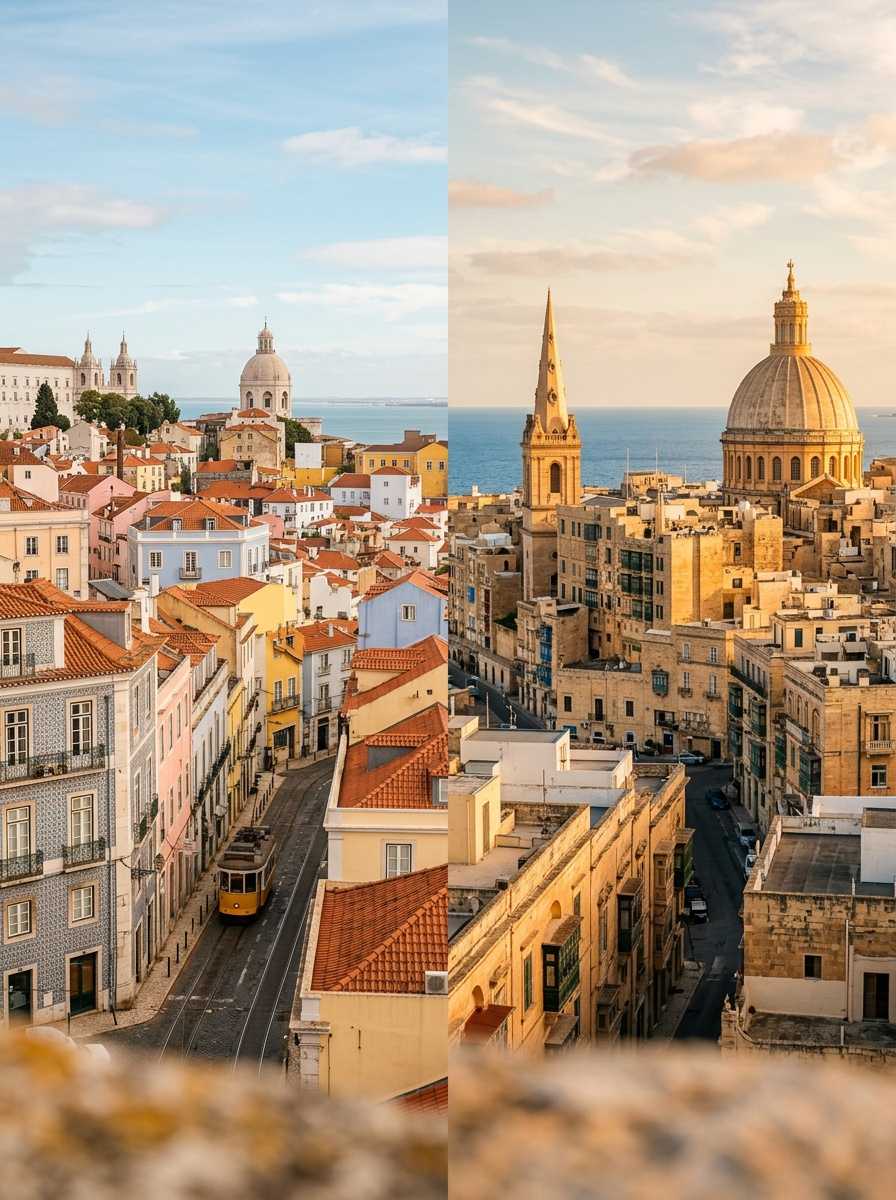
The cost of living in Portugal is well below UK levels. While Lisbon and Porto have become noticeably more expensive in recent years, they remain cheaper than London or Edinburgh. In the Algarve and inland, rent, groceries, and services are significantly lower again. For expats who do not need to be in a major city, the cost structure is one of the strongest arguments for Portugal.
The international expat community in Portugal is large and well-connected. Over the years, networks, English-speaking service providers, and information channels have established themselves in the Algarve, Lisbon, and Cascais. If you are looking to connect, you will find it relatively quickly. However, this community largely keeps to itself. If you want to integrate into Portuguese society, you need to speak Portuguese.
And this is an often-underestimated point: the official language is Portuguese. Dealings with authorities, tax matters, tenancy agreements, and bank correspondence are all in Portuguese. Many younger people in Lisbon speak English, but when dealing with the tax office, social security, and local authorities, language skills or a local advisor are essential. This fundamentally distinguishes Portugal from locations like Malta, where English is an official language.
Portuguese bureaucracy has a mixed reputation. Digital services like the Portal das Finanças are generally functional but slow and sometimes only available in Portuguese. Processing NIF (tax number) applications, social security registrations, and residence permits can take several weeks. Flexibility and patience are required.
Climatically, Portugal is hard to beat. Over 300 days of sunshine a year, mild winters, and one of the longest coastlines in Europe. For expats where quality of life plays a major role alongside tax considerations, Portugal remains a first-class location. The only question is whether the tax side still adds up after the end of the NHR.

Portugal and Malta share some similarities: both are EU members, both have a mild climate, and both are popular with UK expats. But in terms of tax and structure, they are in very different positions following the end of the NHR.
Malta's refund system lowers the effective corporation tax to 5%. This system has been established for decades, is EU-compliant, recognised by the OECD, and has never been called into question. In Portugal, the standard corporation tax has been 19% since 2026, with surcharges pushing the marginal rate up to 29.5%. For entrepreneurs with an active business, this is a substantial difference.
At the individual level, Malta offers the Global Residence Programme (GRP), which is open to non-EU nationals, including UK citizens. It taxes foreign income remitted to Malta at a flat 15%, with a minimum tax of EUR 15,000 per year (EUR 35,000 for applications made from 2027). Malta-source income is taxed at 35%. Unlike IFICI, this programme is not restricted to specific professions or sectors. It is generally open to entrepreneurs, investors, retirees, and digital independents who meet certain minimum requirements.
A practical advantage that is often overlooked: English is an official language in Malta. All government processes, contracts, banking discussions, and tax returns are conducted in English. This significantly reduces reliance on local translators and intermediaries, making daily administration much easier for international expats.
Malta's active double tax treaty with the UK (SI 1995/763) provides clear allocation rules and protection against double taxation. Portugal also has a DTT with the UK, but since Portuguese standard tax rates are higher, the practical advantage is smaller.
This is not meant to be a blanket judgement. Portugal is an excellent place to live in many respects. If you are looking for a lower cost of living, prefer the Atlantic climate, and tax optimisation is not your primary motive, you can live exceptionally well in Portugal. But for expats where the tax structure is a central factor, the baseline has fundamentally changed since 2024.
The IFICI regime (Incentivo Fiscal à Investigação Científica e Inovação) was introduced in 2024 as the successor to the NHR. The name itself reveals its direction: it is about science and innovation, not broad tax-driven location policy. The programme offers a flat income tax rate of 20% on qualifying income for a period of ten years.
Eligibility criteria are strictly defined. Applicants must not have been tax resident in Portugal in the previous five tax years. They must carry out a qualifying activity. The law is tied to the role and type of entity, not to industries: for example research staff, jobs and board positions in certified startups, roles in companies recognised as relevant by AICEP or IAPMEI, or professions on a list of highly qualified professions. Only that list carries a qualification requirement: a doctorate (EQF Level 8) or a degree (EQF Level 6) plus three years of professional experience.
What this means in practice: a software developer with a computer science degree and three years of professional experience, employed by a Portuguese tech company, can benefit from IFICI. An investor with dividend income, a retiree, or a professional poker player cannot. An entrepreneur running their own holding company benefits only in a qualifying set-up, for example as a board member of a certified startup. Freelancers and remote workers whose activity does not fit any of the qualifying categories also fall through the cracks.
For the UK entrepreneurs and expats who made the NHR popular, IFICI is therefore largely irrelevant. It is a skilled worker recruitment programme, not a functional successor to the NHR. Anyone looking for a tax-efficient EU solution as an entrepreneur, investor, or digital independent today must consider other locations.
Location Comparison
Tax regimes, residency programmes, and cost of living in a structured comparison. What matters for entrepreneurs after the end of the NHR.
Dubai CIT: 9 % (above AED 375,000) vs. Malta effective: 5 %
Cyprus CIT: 15 % vs. Malta effective: 5 %
Bulgaria CIT: 10 % vs. Malta effective: 5 %
We analyse your current situation, clarify the tax implications of leaving the UK, and assess whether Malta is the right alternative to Portugal for your profile.
Together, we design the optimal corporate structure in Malta: holding, operating company, refund setup. Tailored to your individual situation and target markets.
We guide you through the entire formation process: articles of association, registration, tax registration, and bank account opening. Timeframe: 6 to 8 weeks.
Organising your change of residence: residence permit, registration, social security arrangements, and finding a home. Everything from a single source.
Bookkeeping, annual accounts, tax returns, and refund applications. We remain your point of contact for all tax and legal matters in Malta.
In a free initial consultation, we assess whether and how Malta works for you.
Senior New Business Manager

Tax Transformation Leader


Transparency matters to us. Here you will find answers to the most common questions on this topic.
No. The NHR regime was closed to new applications at the end of 2024. The transition period ran until March 2025. Individuals who obtained valid NHR status before the deadline retain it until the end of their individual ten-year period. For everyone else, standard Portuguese tax law applies with progressive rates up to 48%.
In most cases, no. Shareholders are excluded in that capacity, and pensions do not fall under the 20% rate. Entrepreneurs can, however, qualify as board members, for example in a certified startup, in a company recognised as relevant by AICEP or IAPMEI, or under a contractual investment incentive. IFICI requires a degree plus professional experience only for the list of highly qualified professions. Passive investors and retirees do not benefit.
Partially. Capital gains from crypto assets held for more than 365 days are tax-free in Portugal. Short-term gains (held for less than a year) are taxed at 28%. Mining income and staking rewards can be classified as commercial income and are then subject to progressive income tax rates.
Malta's Global Residence Programme, which is open to UK nationals as non-EU citizens, taxes foreign income remitted to Malta at a flat 15%. The minimum tax is EUR 15,000 per year, or EUR 35,000 for applications made from 2027. Malta-source income is taxed at 35%. There is no restriction to specific professions. Portugal's IFICI, by contrast, applies only to specific roles and professions. For most UK expat profiles, Malta's programme is much more broadly applicable.
Yes, but in a restricted form. The classic real estate route was closed in most regions in 2023. What remains is the fund option, requiring a minimum investment of EUR 500,000 in qualifying Portuguese investment funds. Processing times have lengthened, and the requirements for fund selection have become stricter.
Next step
In a free initial consultation, we analyse your situation and show you which tax structure in Malta is possible for your profile. Honest, confidential, and with no sales pressure.

Roderick Galea
Managing Partner

Nathaniel Borg
Partner



and the team in Malta

Corporate Services at DW&P Dr. Werner & Partners are provided by DW&P Services Ltd. (C 103208) which is regulated by the MFSA and is licensed under Authorised Person ID: DSER-23577 to carry out the activities of a Class C CSP in terms of the Company Services Providers Act (Cap. 529 of the Laws of Malta).


